Intelligence BuildoutMethodology

Permission — complete text edition

Volume VII / Text edition

Permission

Capital + policy + communities. 15 spreads and 30 pages, with the complete evidence-linked content. No JavaScript is required.

Volume VII

Permission

Capital + policy + communities · 30 pages

Trace the institutional layer that turns technical possibility into operating infrastructure: demand, finance, law, utility decisions, public objectives, community relationships, and lifecycle obligations.

01

Demand, economics, and committed capital

A project becomes credible when workload demand, utilization, financing, power, delivery milestones, and downside risk can be examined together.

Spread 01 / Permission is a system

Volume VII · Orientation

Nothing builds on engineering alone

AI infrastructure must earn capital, legal authority, utility service, institutional trust, and a durable place in its host community.

The previous volumes describe physical possibility: materials, patterned silicon, packages, racks, networks, buildings, cooling, and power. Permission asks a different question—under which financial, legal, political, and social conditions can those systems be built and operated? Each institution sees a different object: an investment, a load request, a land use, an emissions source, a tax base, a security concern, or a neighbor.

The IEA estimates that global data-center electricity consumption rose seventeen percent in 2025, with AI-focused facilities growing faster. Rapid growth compresses decisions that normally unfold on different clocks, forcing model developers, utilities, equipment suppliers, regulators, builders, and communities to confront uncertainty at the same time.Claim

Core proposition: A technically feasible project is not automatically financeable, permitted, interconnectable, publicly acceptable, or resilient through its full life.
Permission is plural
Commercial
A customer, workload, utilization case, and price structure that can support the asset.
Financial
Committed capital with explicit construction, technology, demand, and residual-value risk.
Legal
Authority to build and operate under applicable approvals, conditions, monitoring, and remedies.
Utility
Service whose timing, upgrade scope, operating terms, and cost allocation have been decided.
Social
A durable relationship concerning local burdens, benefits, voice, recourse, and lifecycle obligations.

Decision map

Each approval tests a different claim

The buildout advances when evidence is translated into the language and authority of each decision maker.

The IEA estimates global data-center investment reached roughly half a trillion dollars in 2024. That aggregate is not a count of completed AI campuses, but it conveys the capital intensity of the wider buildout. Investors still need project-level evidence: customer demand, delivery rights, utility arrangements, construction budgets, operating costs, technology assumptions, and risk allocation.Claim

Public authorities apply other tests. Planning bodies examine land use; environmental programs examine air, water, habitat, and cleanup; utilities and commissions examine service and cost allocation; security agencies examine technology and data flows; communities examine local burdens, credibility, and the distribution of benefits. One press release cannot satisfy all of them.

Permission stack
  1. Economic— Show a workload, customer, and operating case.
  2. Financial— Commit capital against schedule and downside risk.
  3. Legal— Secure applicable land, permit, and operating authority.
  4. Utility— Obtain service under transparent technical and cost terms.
  5. Social— Build a relationship that can survive construction and operation.

Build one decision map that links every institutional claim to an owner, authority, evidence item, status date, dependency, affected group, and remedy. A favorable land vote cannot substitute for a utility agreement; a customer announcement cannot substitute for finance; an air permit cannot settle water, noise, tax, or labor questions. The map should also record who can withdraw, appeal, modify, enforce, or renew each permission. That makes disagreement legible and prevents a conditional milestone from being narrated as blanket approval for the full campus life.

Spread 02 / Training, inference, and utilization

Demand formation

Training and inference create different clocks

Capacity plans become more credible when workloads are separated by duration, latency, location, reliability, and scaling behavior.

Training concentrates large pools of accelerators around synchronized jobs that can run for extended periods, checkpoint, restart, and sometimes shift in time or location. Inference serves recurring requests whose latency, availability, privacy, and geographic requirements can favor distributed deployment. Fine-tuning, evaluation, data processing, and synthetic-data generation sit between those simple categories.

PyTorch documents data, fully sharded data, tensor, and pipeline parallelism as complementary approaches to distributed training. Each approach changes how compute, memory, and communication are consumed. A demand forecast that counts accelerators without the workload's parallel structure can misstate network needs, useful utilization, and the amount of capacity a job can actually employ.Claim

Workload characteristics that shape infrastructure
DimensionTraining tendencyInference tendency
TimeLong scheduled jobsContinuous or bursty requests
NetworkIntense collective communicationRequest routing and model serving
LocationCan sometimes follow large compute poolsOften follows users, data, or latency
FailureCheckpoint and job recoveryService redundancy and graceful degradation
Translate workload demand into an investable unit
LayerRequired boundary
ServiceUser, task, latency, quality, availability, privacy, geography, and demand period
WorkloadModel, precision, context, batch, parallelism, data path, and failure recovery
SystemUseful throughput after communication, scheduling, maintenance, thermal, and power limits
FacilityIT and non-IT energy, water, staff, network, spares, rent, and shared services
EconomicsRevenue or value per delivered output under stated utilization, price, life, and financing assumptions

Unit economics

Installed compute is not productive compute

Economic performance depends on how consistently the entire system turns paid-for capacity into useful model work.

Utilization can be lost to data preparation, communication, scheduler gaps, failures, checkpointing, software incompatibility, thermal limits, power constraints, or simply insufficient demand. A high device-activity metric may still hide poor application throughput. Operators need workload-level measures tied to service quality and completed work, not only equipment occupancy.

The IEA estimated that data centers used about 415 TWh globally in 2024. That system-wide estimate should not be allocated to AI or a particular model without measured boundaries. For a project, model economics must connect capital cost, energy, cooling, networking, staff, maintenance, financing, depreciation, and useful output under explicit utilization and hardware-life assumptions.Claim

Economic denominators
Utilization
The defined share of capacity active over a stated time window.
Throughput
Useful work completed per unit of time.
Unit cost
Allocated cost per defined training, inference, or service output.
Service quality
Latency, availability, accuracy, and reliability targets the output must meet.

Utilization is not one number. Device activity, reserved capacity, scheduler occupancy, application throughput, and billable service can move differently. Underwrite them as a time series by workload class, including ramp, maintenance, failures, seasonality, customer concentration, and capacity held for service quality. Stress both excess demand and weak demand: congestion can degrade revenue just as idle equipment can. The audit should show which party bears take-or-pay commitments, curtailment, migration cost, performance penalties, hardware obsolescence, and the gap between technical output and customer value.

Spread 03 / Finance and delivery models

Capital structure

The owner, operator, customer, and lender may differ

Risk changes depending on who owns the land, shell, electrical plant, compute, contract, and obligation to deliver service.

A hyperscaler may develop and operate its own campus, lease powered capacity, or place hardware in a colocation facility. A developer may finance land and infrastructure against customer commitments; utilities may build dedicated or shared upgrades under approved terms; equipment may be purchased, leased, or supplied through service arrangements. Each structure locates completion, demand, technology, and residual-value risk differently.

Global data-center investment reached an estimated half trillion dollars in 2024, according to the IEA. Aggregate spending does not reveal whether a specific project has firm customers, committed equity, closed debt, ordered equipment, utility milestones, or sufficient contingency. Finance diligence must work at that lower level.Claim

Procurement commitments can carry as much schedule risk as financing. DOE reports that distribution-transformer lead times grew from roughly three to six months in 2019 to twelve to thirty months in 2023. That national indicator is not a quote for every project or transformer class, but it demonstrates why equipment slots, specifications, deposits, substitutions, and delivery evidence must be underwritten explicitly.Claim

Diligence questions
  • Who bears cost overruns and schedule delay?
  • Which customer commitments are binding, conditional, or cancellable?
  • When do rent, capacity, or take-or-pay obligations begin?
  • Who owns long-lead equipment if the project stops?
  • What value remains if the intended workload does not arrive?

The four disclosures below describe infrastructure-adjacent spending by different companies, but their accounting definitions and fiscal periods are not harmonized. They are useful as evidence of corporate investment scale, not a project ledger or an AI-only comparison. Read each filing for the included assets, cash versus noncash treatment, leases, depreciation, geographic scope, and period. Never infer completed data-center capacity, utilization, revenue, or financing from expenditure alone; reconcile announcements to balance-sheet additions, cash flow, commitments, and placed-in-service status.

2025 disclosed infrastructure-adjacent capital measures

Microsoft FY2025 property-and-equipment additions alongside Alphabet, Meta, and Amazon calendar-year 2025 capital measures, presented as separate disclosures rather than one standardized industry series.
Company disclosureUSD billions
View chart values
2025 disclosed infrastructure-adjacent capital measures — underlying values in USD billions
CategoryCompany disclosure
Microsoft PPE additions$64.55 USD billions
Alphabet capex$91.4 USD billions
Meta capex$72.22 USD billions
Amazon cash capex$128.3 USD billions

INCOMPATIBLE DEFINITIONS AND FISCAL PERIODS — DO NOT SUM. These are company-wide disclosed measures, not standardized AI-only, data-center-only, project-completion, or cash-flow equivalents.

Underwriting

Scenarios must cross the same boundary

Revenue, power, construction, and technology cases should describe the same project state and operating period.

The IEA base case projects worldwide data-center electricity demand to about 945 TWh in 2030. It is a scenario-dependent projection, not a project revenue guarantee. Deployment, efficiency, utilization, power constraints, and market conditions can move the result. A developer should not treat a macro forecast as a substitute for site-specific demand evidence.Claim

A coherent model aligns delivered megawatts, rack deployment, utilization ramp, customer start dates, tariffs, fuel or energy contracts, maintenance, replacement cycles, and financing terms. Sensitivity analysis should reveal which assumptions control viability and whether downside protections merely transfer cost to customers, utilities, suppliers, or the public.

Forecast discipline: Use macro projections to frame scenarios. Use executed agreements, verified milestones, and bounded assumptions to underwrite an individual project.
Underwrite the party that holds each risk
RiskEvidence and allocation
CompletionFixed or variable scope, contingency, guarantees, delay terms, and acceptance milestone
DemandCustomer credit, commitment duration, termination rights, ramp, price, and concentration
PowerService status, upgrade cost, tariff exposure, curtailment, fuel, and environmental obligations
TechnologyRefresh cadence, vendor support, interoperability, residual value, and redeployment path
RefinancingMaturity, covenants, interest exposure, collateral, cash waterfall, and downside liquidity

Spread 04 / Project states and stranded risk

Status language

Announced capacity is not energized capacity

A project should move through named evidence gates rather than one ambiguous label such as planned or underway.

Announced means an intention has been made public. Land-controlled adds a site right. Permitted means specified approvals are in hand, not that every condition has been satisfied. Utility-approved records a defined service decision. Under construction describes active works. Energized means electrical service is physically available under stated conditions. Operating means systems are commissioned and serving workloads.

These states can overlap by phase: one building may operate while another is only land-controlled. Reporting should name capacity at each stage, the date verified, key conditions, expected transition, and evidence owner. This prevents pipelines from being totaled as if every proposed megawatt will arrive on the same schedule.

Project-state ledger
  1. Announced— Public intent with scope and sponsor.
  2. Land-controlled— Documented right to pursue the site.
  3. Permitted— Applicable approvals obtained for the stated phase.
  4. Utility-approved— Service terms, upgrades, and milestones defined.
  5. Energized— Commissioned capacity available to operate.
Use an evidence-backed project-state ladder
  1. Proposed— A sponsor has described intent, scope, place, and timing without implying authority or funding.
  2. Controlled— Land or another essential right is evidenced, including conditions and expiration.
  3. Authorized— Named approvals cover defined work; remaining conditions and appeals stay visible.
  4. Financed— Capital is committed under disclosed closing conditions and risk allocation.
  5. Delivered— Built, energized, commissioned, staffed capacity is accepted for a stated operating use.

Downside

Stranding can occur at every layer

A building may be complete yet unable to obtain power, fit current hardware, win customers, or operate economically.

LBNL's 2030 reference case for U.S. data-center electricity use includes wide compounded-uncertainty bounds rather than a single certain future. The IEA global outlook is also scenario-dependent. Together they show why planners should stress deployment, efficiency, workload, and infrastructure assumptions rather than extrapolate one growth line.ClaimClaim

Stranding risk includes an unavailable interconnection, changed permit conditions, construction inflation, obsolete rack geometry, inadequate cooling, network limitations, customer concentration, model-efficiency shifts, export restrictions, or a local relationship that collapses. Modular phasing and reusable utility infrastructure can preserve options, but only when the alternate use is technically and contractually realistic.

Stranding test by layer
LayerFailure modePreserved option
SiteApproval or community conflictPhased footprint or alternate use
PowerUpgrade delay or tariff mismatchFlexible ramp and service terms
TechnicalRack or cooling obsolescenceReplaceable modules and broad envelopes
CommercialDemand or customer shiftDiversified contracts and divisible capacity
Stranded-risk tests for every phase
  • If the customer, model generation, or utilization case changes, which shell, power, cooling, and network assets remain useful?
  • Which shared infrastructure was sized for later phases, and who pays if those phases never proceed?
  • Can permits, utility rights, incentives, equipment orders, or land options expire before dependent milestones arrive?
  • What restoration, debt, lease, tax, labor, and community obligations survive cancellation or ownership transfer?
  • Does the published status distinguish sunk cost, committed cost, work in progress, mechanically complete assets, and commissioned service?
02

Industrial policy and geopolitical boundaries

Public policy shapes where capacity is built, which technology may move, who bears strategic risk, and what governments expect in return.

Spread 05 / Semiconductor incentives

United States

Incentives purchase public objectives

Public funding is not merely cheaper capital; it carries program goals, eligibility rules, milestones, reporting, and political accountability.

The U.S. CHIPS and Science Act provides 52.7 billion dollars over five years, including manufacturing incentives and research-and-development funding. NIST's awards catalog, updated August 2026, distinguishes proposed and final project records. Final direct-funding amounts are maximum, milestone-based awards—not evidence of cash disbursed, completed construction, qualified output, or private investment realized.ClaimClaim

Industrial-policy programs can seek domestic capacity, supply resilience, technology leadership, national security, workforce development, regional growth, or research infrastructure. A recipient must translate those objectives into project scope and compliance systems. Analysts should distinguish authorization, appropriation, award announcement, executed agreement, disbursement, milestone achievement, and operating output.

Five-year U.S. CHIPS and Science Act program total summarized by NIST
$52.7B
Evidence class
fact
Claim
claim-chips-funding
Context
Not a measure of money already disbursed or productive capacity achieved.
A public-support ledger needs both sides of the bargain
Public contributionAuditable counterpart
Grant or creditEligible cost, actual investment, placed-in-service date, and repayment trigger
Tax exemptionBaseline law, foregone revenue, duration, beneficiary, and independent fiscal estimate
InfrastructureAsset owner, other users, operating cost, maintenance duty, and residual value
Workforce supportJob quality, recruitment area, training completion, placement, retention, and accessibility
Performance promiseMetric, deadline, reporting frequency, verification right, remedy, and successor obligation

European Union

A target expresses policy intent, not outcome

Market-share ambitions become meaningful only through facilities, workforce, suppliers, customers, energy, and sustained production.

The European Chips Act sets a goal of doubling the EU share of global semiconductor production to twenty percent by 2030. The figure is a policy target, not a forecast. The 2023 act remains in force while Chips Act 2.0, presented in June 2026, remains a proposal; analysis must not treat the proposal as enacted replacement law.ClaimClaim

Comparing industrial-policy programs requires more than headline currency conversion. Programs may support factories, equipment, research, tax credits, loans, infrastructure, skills, or strategic coordination, and they may measure success differently. Public value should be evaluated against additional capacity, capability, resilience, spillovers, labor outcomes, environmental performance, and the opportunity cost of support.

Policy ledger: Record the objective, mechanism, legal status, effective date, beneficiaries, risk bearers, milestones, and last verification date for every program claim.

Evaluate incentives against a documented counterfactual: what investment, site, timing, and public revenue would likely occur without the support? Separate statutory maximum, awarded amount, claimed amount, cash paid, and verified performance. Benefits should be measured net of public infrastructure, administration, financing, displacement, and environmental or service costs rather than quoted only as gross investment. Durable agreements publish definitions, beneficiary ownership, audit access, change-of-control treatment, clawback calculation, appeal process, and enforcement history. Confidentiality should not erase the public's ability to test value received.

Spread 06 / Export controls and security

Technology movement

Controls follow capability through the stack

Rules may attach to equipment, software, components, destinations, end users, end uses, support, or the knowledge needed to operate a system.

The U.S. December 2024 package added controls covering categories of semiconductor-manufacturing equipment, software tools, and high-bandwidth memory, together with Entity List additions. The counts describe that dated package, not the entire current regime. The consolidated EAR contains transaction-specific exceptions, while a January 2026 BIS announcement describes case-by-case review for H200, MI325X, and similarly performing chips under stated conditions. Current text and transaction facts must be checked before action.ClaimClaimClaim

Compliance begins with product and party data: technical classification, performance thresholds, destination, ownership, consignee, end user, intended use, service access, and transaction parties. Engineering changes can alter classification; corporate changes can alter party risk. A static country label is therefore not a complete control process.

Status rule: Export-control summaries age quickly. Treat them as dated orientation and verify the current rule, license requirements, exceptions, and party status before action.
Turn a trade rule into a controlled transaction
  1. Classify— Identify the item, software, technology, performance parameters, origin, and relevant control basis.
  2. Screen— Resolve parties, ownership, location, end use, end user, diversion signals, and restricted support.
  3. Authorize— Document the license, exception, conditions, validity period, quantities, and reporting duty.
  4. Control— Limit physical, electronic, cloud, service, and deemed access throughout delivery and support.
  5. Monitor— Retain records, reassess changes, investigate anomalies, stop transfers, and escalate disclosures.

System response

Security policy reshapes industrial geography

Restrictions can redirect design, supplier qualification, capacity investment, product configuration, service models, and alliance strategy.

Semiconductor design, materials, equipment, fabrication, and assembly remain distributed across specialized regional clusters. That structure creates multiple control points and makes unilateral changes propagate through firms and countries that perform different stages of one product route.Claim

Firms may create market-specific products, relocate support functions, qualify new suppliers, add screening, or reconsider joint research and cloud access. Governments must weigh security objectives against enforceability, allied coordination, domestic industry effects, substitution, and the time needed to build alternate capacity. Evidence should separate the rule's stated objective, legal coverage, observed compliance behavior, and measured industrial outcome.

Four records that should remain separate
RecordQuestion
RuleWhat conduct and technology are legally covered, and when?
LicenseWhich transaction received permission under what conditions?
ComplianceHow did organizations classify, screen, and control access?
OutcomeWhat changed in capability, trade, investment, or security?
Security policy has operational costs and failure modes
  • Record the rule version and effective date; product classifications and authorization pathways can change.
  • Map cloud access, remote diagnostics, model weights, source code, design files, and maintenance—not only shipped hardware.
  • Test beneficial ownership, resellers, subsidiaries, transshipment, and changes in intended use without stereotyping geography.
  • Separate legal eligibility from vendor capacity, technical support, interoperability, and economically usable supply.
  • Provide employee training, escalation, independent testing, incident response, remediation, and protection against retaliatory pressure.

Spread 07 / Data sovereignty and strategic autonomy

Jurisdiction

Location is only one layer of control

Data, models, keys, administrators, support access, networks, hardware, and corporate authority may sit under different jurisdictions.

A sovereignty requirement may concern where data is stored, where it is processed, who can administer systems, which law can compel access, how encryption keys are controlled, or whether hardware and software remain supportable during geopolitical stress. Those are different requirements and should be written separately before an architecture is chosen.

A locally sited facility can still depend on foreign chips, firmware, cloud control planes, network operations, spare parts, and corporate decisions. Conversely, cross-border services can incorporate segmentation, local key control, auditable access, and contractual safeguards. The useful question is which authority and dependency must be controlled for the specified risk—not whether a map pin sits inside a border.

Sovereignty dimensions
Residency
Where defined data is stored or processed.
Administrative control
Who can configure, access, or support the system.
Legal reach
Which authorities can compel action or disclosure.
Operational autonomy
Whether service can continue through external disruption.
Sovereignty claims operate at different layers
LayerControl question
DataWhich law, location, access, retention, transfer, and deletion rules govern each class?
ComputeWho owns, schedules, services, updates, and can disconnect the hardware and facility?
ModelWho controls weights, training data, evaluation, deployment, modification, and export?
SupplyWhich foreign tools, chips, software, energy, networks, and specialists remain indispensable?
AuthorityWhich court, regulator, contract, audit right, and remedy can compel or prevent action?

Strategic capacity

Autonomy is built across a dependency graph

Domestic production goals and technology controls address some dependencies while creating cost, scale, and coordination tradeoffs.

The European Chips Act's production-share target expresses a strategic objective to strengthen regional capability; U.S. export controls express a different objective around technology access and national security. Neither policy claim, by itself, establishes end-to-end autonomy across design, equipment, materials, fabrication, packaging, cloud operations, and energy.ClaimClaim

A resilience plan should identify the service that must continue, the disruption it must survive, the acceptable degradation, and the recovery period. It can then combine trusted suppliers, inventories, diversified regions, interoperable designs, local skills, controlled access, legal agreements, and tested continuity procedures. Autonomy without a bounded threat model becomes an unlimited and unmeasurable objective.

Evidence boundary: Policy goals, legal controls, industrial capacity, and operational resilience are related but distinct. Report each with its own status and evidence.

Ireland's regulator reports the national electricity share of data centers as an observed five percent in 2015 and twenty-two percent in 2024, with thirty-one percent for 2034 presented as a projection. This is a country-level electricity-demand share, not an AI-only measure, installed-capacity ratio, or forecast for every grid. The sequence shows why sovereignty and infrastructure policy converge: connection rules must address system adequacy, location, flexibility, and decarbonization while preserving transparent assumptions and a route to revise forecasts.

Irish data-center share of national electricity demand

CRU-reported historical shares for 2015 and 2024 with the regulator's projected share for 2034.
Data-center sharePercent of national electricity demand
View chart values
Irish data-center share of national electricity demand — underlying values in Percent of national electricity demand
CategoryData-center share
2015 observed5% Percent of national electricity demand
2024 observed22% Percent of national electricity demand
2034 projected31% Percent of national electricity demand

NATIONAL ELECTRICITY-DEMAND SHARE — 2015 and 2024 are historical; 2034 is PROJECTED. Not an AI-only share, capacity factor, or transferable forecast for other power systems.

Spread 08 / Public authority and infrastructure choices

Institutional map

There is no single energy approver

Federal agencies, state commissions, grid operators, utilities, local governments, and resource regulators exercise different powers.

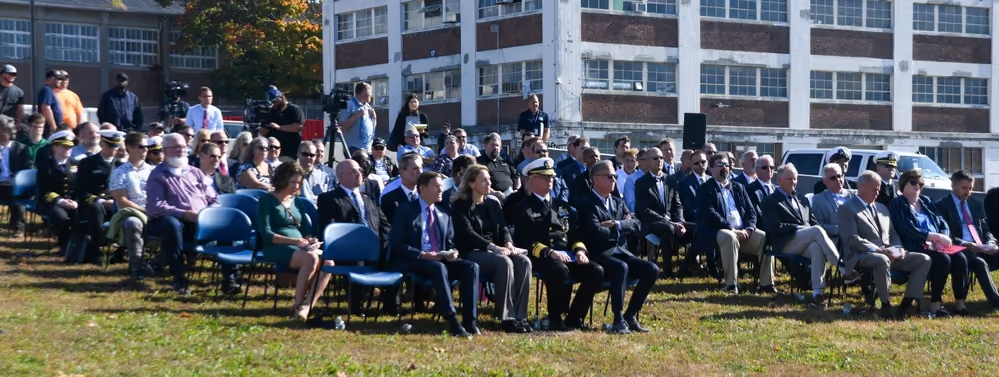
Military personnel, public officials, and guests seated outdoors at a military microgrid ribbon-cutting ceremony.

Military personnel, public officials, and guests attend a military microgrid ribbon-cutting, illustrating the institutional setting around public energy infrastructure.

This public-domain image documents a military microgrid event. It is not a data-center project and does not evidence approval of any AI facility.DVIDS marks the item public domain. The event illustrates public governance around energy infrastructure; it is not a data-center project. The appearance of U.S. Department of War (DoW) visual information does not imply or constitute DoW endorsement. Individuals' publicity and privacy rights are not waived.U.S. Navy photo by MC2 Maxwell Higgins, via DVIDS, public domain.Original sourceU.S. government work / public domain

FERC regulates specified interstate electricity matters and wholesale market structures; NERC develops and enforces reliability standards under federal oversight; regional operators plan and operate organized systems in much of the country; state commissions oversee utilities and retail terms under state law; local bodies govern land use and construction. Authority changes with the asset and transaction.

A private power contract cannot displace a required interconnection study, utility tariff, environmental permit, zoning decision, or reliability obligation. Project maps should show the legal authority, technical decision, cost decision, schedule, public process, and appeal or compliance path for each institution involved.

Public actors hold different mandates
Legislature
Creates authority, appropriates funds, sets eligibility, and can require disclosure or review.
Regulator
Applies delegated standards through records, evidence, procedure, and appeal.
Utility
Plans and operates infrastructure under service, reliability, and cost-recovery obligations.
Local government
Exercises land-use, building, emergency-service, tax, and community-facing authority.
Independent auditor
Tests reported inputs and performance without replacing the lawful decision maker.

Generation pathways

Technology changes the regulatory route

A renewable contract, gas plant, transmission upgrade, microgrid, and new reactor do not seek permission through the same institutions.

FERC Order No. 2023 reforms generator-interconnection processes through cluster studies, project-readiness requirements, and transmission-provider delay penalties. The rule is effective, but FERC's chair said in June 2026 that transmission-provider compliance was not fully complete. It therefore cannot be read as a universally implemented tariff or project schedule.ClaimClaim

The NRC regulates the design, siting, construction, and operation of new commercial nuclear facilities, with formal opportunities for public involvement. A data center considering nuclear supply must distinguish buying energy from the grid, contracting with an existing plant, colocating with generation, and developing a new facility; each creates different technical and legal questions.Claim

Governance test: Name the physical asset, commercial arrangement, interconnection point, jurisdiction, and operating responsibility before describing a power solution as approved.
Compare policy regimes by mechanism, not slogan
DimensionComparison test
EntryWho may connect or build, under which threshold, sequence, and evidence standard?
AllocationHow are scarce grid, water, land, spectrum, labor, and public funds prioritized?
ConditionsWhich efficiency, flexibility, security, labor, local-benefit, and reporting duties apply?
AccountabilityWho verifies compliance, hears objections, publishes decisions, and imposes remedies?
AdaptationHow can rules change without retroactive ambiguity, stranded public cost, or arbitrary treatment?
03

Permits, utilities, and the local project

Permission is assembled site by site through jurisdiction-specific land, environmental, infrastructure, utility, construction, and operating decisions.

Spread 09 / The permit stack

Jurisdiction

A data center has no universal permit

Applicable reviews follow the site, project configuration, associated infrastructure, resource impacts, and governmental actions involved.

Congressional Research Service finds that individual data centers typically fall under state and local siting, while the federal nexus varies by project. FERC, NRC, the Army Corps, and delegated air and water programs may apply depending on location and configuration. The report is a jurisdictional map, not a permit determination for any site.Claim

A July 2025 executive order directs federal agencies to examine categorical exclusions, FAST-41 coordination, brownfield guidance, and federal-site opportunities for data-center infrastructure. These are review and coordination mechanisms, not permits; they do not predetermine outcomes or erase substantive project requirements.Claim

The stack can include zoning, subdivision, site plan, building, fire, stormwater, road access, wetlands, water withdrawal, wastewater, air emissions, cultural resources, threatened species, transmission, generation, and utility approvals. Some apply to the campus; others attach to a substation, pipeline, backup system, or off-site upgrade.

Legal boundary: Permit applicability is project- and jurisdiction-specific. A public explainer can map questions, but current counsel and agency records determine the actual route.
Build one permit logic from many authorities
  1. Scope— Freeze the project boundary, alternatives, phases, enabling works, and operating scenario.
  2. Trigger— Map each land, air, water, species, heritage, safety, building, and utility authority.
  3. Sequence— Link applications, studies, consultations, hearings, appeals, construction, and renewal dates.
  4. Condition— Translate limits and mitigations into design criteria, contracts, procedures, meters, and budgets.
  5. Assure— Assign monitoring, certification, reporting, inspection, enforcement, and closure responsibilities.

Dependency schedule

Approvals are a network, not a checklist

A late design change can reopen several decisions when permits, utility studies, and construction documents share the same assumptions.

EPA's 2026 redevelopment guidance says candidate sites should fit site conditions, reach power and fiber, comply with regulation and cleanup controls, and incorporate planning and community input. The guidance concerns redevelopment screening and does not confer approval, but it demonstrates how physical suitability, legal compatibility, and engagement intersect.Claim

A permit matrix should connect each decision to the design basis it relies on: acreage, building envelope, generators, fuel, cooling, water, discharge, traffic, noise, lighting, construction phases, and operating hours. Teams should record submission, completeness, review, conditions, appeal, expiration, modification triggers, and compliance reporting separately.

Permit control
  1. Screen— Identify site conditions and potential jurisdictions.
  2. Define— Freeze enough project scope to support review.
  3. Submit— Provide complete applications and underlying studies.
  4. Resolve— Address comments, alternatives, and conditions.
  5. Comply— Track construction and operating obligations after approval.
Approval language must survive operational handoff
Permit artifactControl it should become
Approved drawingConfiguration baseline with field-verification and change-control requirements
Numerical limitCalibrated measurement, averaging period, data retention, alarm, and response owner
Mitigation promiseFunded scope, delivery date, acceptance test, maintenance plan, and public evidence
Reporting conditionNamed preparer, reviewer, due date, source record, correction route, and archive
Closure dutyTrigger, financial assurance, removal or reuse standard, restoration, and successor liability

Spread 10 / Environmental review and participation

Participation

Review works best before choices harden

Environmental analysis and public participation can surface site knowledge, alternatives, cumulative burdens, and design changes while they remain actionable.

Project representatives speaking with local residents around maps at a formal environmental-review meeting.

Project representatives speak with residents around maps during a formal environmental-review meeting.

This public-domain photograph illustrates a NEPA participation setting for a military project. It does not depict a data-center review or imply that one meeting creates consent.DVIDS marks the item public domain. The image illustrates a NEPA participation setting and does not depict a data-center project. The appearance of U.S. Department of War (DoW) visual information does not imply or constitute DoW endorsement. Individuals' publicity and privacy rights are not waived.DoD photo by U.S. Army Sgt. Kyler Chatman, via DVIDS, public domain.Original sourceU.S. government work / public domain

A federal environmental-review process may arise when a project has the necessary federal nexus; state and local review laws can create separate requirements. The applicable process depends on governmental action and project facts. Public participation may include notices, document review, hearings, written comments, consultations, responses, and opportunities to challenge decisions.

Participation is most useful when materials are understandable, alternatives are genuine, translation and access needs are addressed, and the project explains what feedback changed. A record of comments is not the same as agreement, and a sparsely attended meeting is not evidence that affected people lack concerns.

Review the project as a lifecycle system
BoundaryEffects to test
UpstreamMaterials, equipment manufacture, generation, fuel, water supply, transmission, and transport
ConstructionLand conversion, traffic, noise, dust, habitat, workforce, waste, safety, and temporary utilities
OperationPower, backup generation, water, discharge, chemicals, refrigerants, noise, light, and emergency events
CumulativeExisting and reasonably foreseeable projects sharing airshed, watershed, grid, roads, housing, or services
End of lifeRefresh waste, hazardous material, removal, reuse, site restoration, monitoring, and financial responsibility

Impact boundary

The campus boundary is not the impact boundary

Power generation, transmission, water supply, roads, housing, waste, and construction logistics may carry effects beyond the parcel.

CRS emphasizes that the federal permitting nexus varies with project configuration and location. A complete review map therefore follows associated infrastructure and governmental decisions rather than assuming every effect belongs to one lead campus approval.Claim

EPA's redevelopment guidance highlights site conditions, regulation, cleanup controls, infrastructure access, planning, and community input. Those screens can expose cumulative questions early: whether a new load shifts generation, whether water withdrawals interact with existing users, whether backup engines affect local air, and whether a brownfield remedy is compatible with construction.Claim

Keep impact scopes explicit
ScopeExamples
DirectLand disturbance, cooling, generators, noise, and traffic on site
ConnectedSubstations, lines, pipelines, water, wastewater, and roads
CumulativeCombined pressure from existing and foreseeable activity
LifecycleConstruction, operation, equipment refresh, and decommissioning
Participation is evidence production, not a meeting count
  • Publish a stable project description, alternatives, methods, assumptions, maps, source data, and uncertainty in usable formats.
  • Provide language, disability, timing, transportation, childcare, and technical-support access suited to affected participants.
  • Track each material comment to a response, design change, mitigation, monitoring term, or reasoned rejection.
  • Distinguish outreach from legally required consultation and identify which authority can alter or deny the proposal.
  • Keep participation open through construction and operation with accessible complaints, response deadlines, escalation, and non-retaliation.

Spread 11 / Utility service and cost allocation

Service request

A large load changes planning assumptions

Utilities must determine whether, when, and under what operating conditions the system can serve a project reliably.

A load study examines location, magnitude, ramp, hourly profile, power quality, redundancy, restoration expectations, and interactions with transmission and distribution. The result may require substations, lines, transformers, protection, generation, or operating agreements. A reservation in a queue is not the same as completed network capability.

LBNL's 2030 U.S. reference case is 649 TWh with broad compounded-uncertainty bounds. It is a national scenario, not a utility forecast, but it shows why planners need transparent, regularly refreshed load pipelines. Duplicate requests, speculative phases, efficiency changes, and cancellations can otherwise drive both overbuild and delayed preparation.Claim

Service evidence
  • Phased load with realistic commissioning and utilization dates
  • Power-factor, harmonics, ride-through, and ramp characteristics
  • Firmness, curtailment, backup, and restoration requirements
  • Collateral, milestones, withdrawal, and upgrade responsibility
  • Conditions for energization and continuing operation
Allocate utility costs by cause, timing, and risk
Cost layerQuestions for the record
DedicatedWhich interconnection, substation, feeder, metering, and protection assets serve the applicant?
Shared networkWhich transmission or distribution upgrade benefits other loads, generators, or future growth?
Power supplyWho bears energy, capacity, congestion, losses, reserves, fuel, and environmental compliance?
StrandingWhat happens if the load arrives late, underuses service, relocates, defaults, or closes?
Credit and securityWhich deposit, guarantee, minimum bill, contract term, and true-up protects other customers?

Rate design

Who pays is a public-policy question

Cost allocation determines whether infrastructure risk sits with the project, a customer class, utility investors, generators, or the wider public.

Utilities and commissions can consider line-extension policies, contributions in aid of construction, minimum-demand terms, contract duration, exit fees, security, special tariffs, riders, interruptibility, and treatment of shared upgrades. The governing options vary by jurisdiction and utility structure. Transparent proceedings should distinguish project-specific facilities from network investments that serve broader users.

FERC's generator-interconnection reform concerns generation queues, not retail data-center tariffs, but it illustrates the importance of readiness requirements, cluster planning, and accountability for delay. Large-load policy needs its own defined rules so speculative requests do not block credible projects and stranded upgrades do not silently migrate to other customers.Claim

Distributional test: For every proposed cost rule, name the beneficiary, risk bearer, exit condition, stranded-cost path, and evidence available to the public decision maker.

Virginia's legislative analysts modeled a wide range of future system outcomes and estimated that by 2040 residential customers could pay between fourteen and thirty-seven dollars more per month under the examined data-center demand cases. These are modeled statewide monthly effects, not current bills, a tariff decision, or a prediction for every household. The useful audit question is which load, generation, transmission, financing, contract, and cost-allocation assumptions drive the range—and which enforceable customer protections remain if projects arrive late or consume less than forecast.

Modeled Virginia residential monthly cost effect in 2040

JLARC's modeled low and high residential monthly cost effects for 2040 under the data-center demand scenarios it examined.
Residential monthly cost effectUSD per month
View chart values
Modeled Virginia residential monthly cost effect in 2040 — underlying values in USD per month
CategoryResidential monthly cost effect
2040 modeled low$14 USD per month
2040 modeled high$37 USD per month

VIRGINIA MODEL RANGE FOR 2040 — not a current bill increase, adopted tariff, household guarantee, or estimate for another utility system.

Spread 12 / Siting, operating conditions, and enforcement

Conditions

Approval begins an operating obligation

Noise, water, emissions, traffic, lighting, construction hours, emergency systems, and site cleanup may remain governed long after a ribbon cutting.

EPA's redevelopment guidance links candidate-site fit with power and fiber access, regulatory compliance, cleanup controls, planning, and community input. CRS likewise shows that jurisdiction follows project configuration. Together they argue for an operating register that ties each condition to a responsible owner, monitoring method, reporting date, and corrective path.ClaimClaim

St. Louis's April 2026 Armory approval provides a project-level example: the city published conditions for cooling and water, noise and generator operation, PUE, heat-rejection and reuse reporting, certified e-waste handling, decommissioning, long-duration job floors, and financial or occupancy remedies. These are auditable obligations and future commitments—not evidence that the projected facility performance, jobs, tax receipts, or community benefits have already been delivered.Claim

Some obligations are physical—installing noise attenuation or stormwater controls. Others are procedural—maintaining records, testing equipment, notifying agencies, or opening complaint channels. Conditions also need change control: new generators, cooling modes, fuel, load, building phases, or operating schedules may trigger review rather than fit automatically under the original approval.

Compliance loop
  1. Translate— Turn permit text and commitments into operating requirements.
  2. Assign— Name an accountable owner and backup.
  3. Measure— Collect evidence at the required boundary and cadence.
  4. Report— Submit and disclose information through the proper channel.
  5. Correct— Investigate deviations and verify closure.
Operating assurance has distinct instruments
Condition
A binding design, operating, monitoring, reporting, mitigation, or closure requirement.
Indicator
A measured signal that describes performance but is not automatically a legal limit.
Inspection
A documented examination of records, equipment, site conditions, or operating practice.
Violation
A failure to meet an applicable duty under the rule and evidence standard.
Remedy
A corrective, compensatory, restrictive, financial, or legal response with an enforceable endpoint.

Water evidence

A ratio without a boundary cannot settle a local question

Cooling design, climate, utilization, water source, treatment, and accounting definitions can materially change facility water use.

LBNL estimated average U.S. data-center site water usage effectiveness at just over 0.36 liters per kilowatt-hour through 2023. The estimate is a modeled national average; individual facilities vary materially. It should not be applied to a proposed site without a compatible WUE definition, load profile, cooling mode, and climate assumption.Claim

A local utility record answers a different question. Prince William County reported that 25 operating data-center buildings averaged about 18,000 gallons per building on an average day and about 88,000 gallons on a maximum day. Together they represented about 1.5 percent of Service Authority average-day demand and 3.9 percent of maximum-day demand. Those historical building and system boundaries should remain attached; they are not a campus design allowance or a national benchmark.Claim

Local review also asks questions a ratio cannot answer: source reliability during drought, competing users, seasonal peaks, treatment energy, wastewater destination, chemical handling, emergency operation, and whether water-saving modes increase electricity or other impacts. A project should disclose both annual totals and relevant peak conditions under defined operating scenarios.

Modeled average U.S. site WUE through 2023
>0.36 L/kWh
Evidence class
estimate
Claim
claim-us-average-wue-2023
Context
Not a project-specific rate; accounting boundary and cooling design matter.
Make conditions enforceable in operation
  1. Translate— Convert approval text into equipment, procedures, meters, records, training, and budget.
  2. Verify— Use calibrated data, independent review, inspections, and source records at the stated boundary.
  3. Publish— Report comprehensible results, outages, exceedances, corrections, and unresolved uncertainty on schedule.
  4. Correct— Contain harm, diagnose cause, implement action, test effectiveness, and compensate where required.
  5. Escalate— Apply transparent notices, penalties, operating restrictions, financial assurance, or revocation when warranted.
04

Communities, consent, and the full lifecycle

A durable project makes benefits and burdens legible, engages sovereign and local communities on their own terms, and plans for refresh and closure before construction.

Spread 13 / Benefits, burdens, and public sentiment

Local relationship

People experience projects through distribution

A regional benefit can coexist with a concentrated neighborhood burden; an aggregate tax claim can coexist with household cost concern.

An environmental specialist discussing project-impact display boards with a member of the public at a meeting.

An environmental specialist discusses project-impact displays with a member of the public at an open meeting.

This public-domain image concerns a federal base expansion, not a data-center hearing. It illustrates a participation mechanic and does not prove community consent or represent public sentiment.DVIDS marks the item public domain. The meeting concerns a federal base expansion and illustrates participation mechanics, not a data-center hearing. The appearance of U.S. Department of War (DoW) visual information does not imply or constitute DoW endorsement. Individuals' publicity and privacy rights are not waived.U.S. Coast Guard photo by PO3 Michael Clark, via DVIDS, public domain.Original sourceU.S. government work / public domain

Potential benefits include construction work, permanent operations roles, supplier demand, tax revenue, infrastructure investment, training, and reuse of difficult sites. Virginia JLARC estimated 74,000 supported jobs, 5.5 billion dollars of labor income, and 9.1 billion dollars of GDP annually, while finding that most economic benefit came from construction and that data-center revenue ranged from under one percent to thirty-one percent of total local revenue across five mature local markets. These are statewide and local-market estimates, not promises for a new project.ClaimClaim

Potential burdens include electricity-cost exposure, land conversion, water demand, emissions, noise, traffic, housing pressure, visual change, construction disruption, and opportunity costs. JLARC modeled generation- and transmission-related costs of fourteen to thirty-seven dollars per month in real 2040 dollars for a typical Dominion residential customer under its scenarios. It also found one-third of Virginia data centers near residential areas, documented low-frequency noise challenges at some sites, and recommended explicit local authority to require proposed water-use estimates. None of those findings is a universal facility forecast.ClaimClaimClaim

Temporary and permanent jobs should be separated, as should gross tax revenue and net fiscal effect after incentives or public infrastructure. St. Louis's Armory framework illustrates the distinction: it specifies escalating twenty-year job minimums, projected-tax shortfall damages, operating conditions, and enforcement routes. The existence of those terms is evidence of an accountable commitment structure; employment, revenue, environmental performance, and payments remain future results that must be reported separately.Claim

Distribution matters as much as the total
AccountDisaggregate by
EmploymentConstruction versus permanent work, occupation, wage, benefits, duration, residency, and contractor tier
Public revenueTax type, exemption, jurisdiction, timing, volatility, service cost, and restricted use
InfrastructurePayer, owner, beneficiary, capacity reservation, maintenance, resilience, and stranded risk
EnvironmentLocation, population, existing burden, exposure pathway, duration, cumulative effect, and remedy
Community valueEligible recipients, selection process, delivery evidence, governance, enforcement, and life after closure

Polling

National opinion is context, not local consent

Representative surveys, hearing comments, organized campaigns, elections, and project agreements measure different things.

In Pew's January 2026 U.S. survey, thirty-nine percent said data centers were mostly bad for the environment, thirty-eight percent mostly bad for home energy costs, and thirty percent mostly bad for nearby quality of life. In the same survey, twenty-five percent called them mostly good for local jobs and twenty-three percent mostly good for tax revenue.ClaimClaim

Those estimates describe a national probability-based survey at one moment. They do not predict sentiment around a specific project. Public-hearing comments are valuable stakeholder positions but self-selected; they are not representative polling. Strong reporting keeps each evidence type separate and publishes question wording, field dates, population, method, and project context.

No sentiment score: Do not collapse conflicting values into one approval number. Show who holds a position, what evidence supports it, and which decision or commitment it concerns.
Questions that expose uneven outcomes
  • Who receives the benefit, who experiences the burden, who decides, and who can appeal or enforce?
  • Are jobs counted as job-years, peak construction roles, unique workers, permanent positions, or indirect model estimates?
  • Do regional averages hide noise, traffic, air, water, housing, or service effects concentrated near one community?
  • Are promised benefits additional, funded, time-bound, accessible, independently verified, and protected through ownership change?
  • Does the analysis include opportunity cost: alternative uses of land, grid capacity, water, public finance, and skilled labor?

Spread 15 / Refresh, e-waste, and decommissioning

Equipment refresh

The permission to build includes the obligation to retire

Accelerators, storage, batteries, power systems, and cooling equipment age on different schedules and leave different records and material streams.

UNITAR estimates that the world generated sixty-two million tonnes of electronic waste in 2022, with only 22.3 percent documented as formally collected and recycled. This is a global all-electronics estimate, not a data-center or AI subtotal. It supplies context for why asset disposition requires traceable evidence.Claim

Refresh planning should begin with asset identity, data sensitivity, condition, remaining workload value, repairability, energy performance, warranty, spares, and software support. EPA's federal-equipment hierarchy places reuse and redeployment of functional electronics ahead of recycling, with repair, refurbishment, component harvesting, and secure data handling used where practicable. The guidance is not a measured private-sector reuse rate, but it establishes the operational sequence this field guide applies.Claim

When recycling is appropriate, contracts should control custody, worker and environmental practices, downstream processors, recovered fractions, and residual disposal.

Asset disposition
  1. Assess— Record condition, support, performance, and data risk.
  2. Sanitize— Verify data destruction against the asset type.
  3. Redeploy— Match useful equipment to a less demanding role.
  4. Recover— Harvest parts and route remaining material responsibly.
  5. Verify— Retain chain-of-custody and downstream treatment evidence.
Fund the full asset lifecycle at project approval
PhaseObligation to preserve
RefreshData security, safe removal, configuration records, redeployment test, warranty, and downtime plan
ReuseIdentity, function, remaining-life evidence, support, destination, labor standard, and chain of custody
RecyclingAuthorized processor, hazardous fractions, recovery route, downstream due diligence, and mass balance
ClosureNotice, workforce transition, utility release, hazardous material, asset removal, and site restoration
Financial assuranceCost estimate, inflation, trigger, protected funding, independent access, and successor liability

Closure

Decommissioning is a design requirement

A closure plan protects communities, capital providers, utilities, and future land users when a facility changes or stops operating.

UNITAR projects global electronic waste reaching eighty-two million tonnes in 2030 under current trends. The projection is not AI-specific, and policy, reuse, repair, collection, and recycling can change the outcome. Its relevance is the scale of the wider system into which rapid hardware refresh will feed.Claim

Decommissioning should address customer and worker transition, data destruction, equipment removal, batteries and fuels, refrigerants and fluids, utility disconnection, permit closure, contaminated materials, demolition or adaptive reuse, financial security, and long-term monitoring. Commitments should survive ownership changes. The intelligence buildout is complete only when its physical liabilities and public promises remain traceable from announcement through final disposition.

Projected global e-waste in 2030 across all electronic-equipment categories
82 Mt
Evidence class
projection
Claim
claim-ewaste-2030
Context
A global trend projection, not a forecast for data centers alone.
Final handoff: Permission is not a one-time gate. It is a lifecycle record linking capital, authority, operations, impacts, commitments, refresh, and closure.
Close the evidence loop
  1. Inventory— Maintain asset, material, chemical, data-bearing device, ownership, and condition records.
  2. Decide— Apply a documented hierarchy for continued use, repair, redeployment, parts, recycling, or disposal.
  3. Transfer— Control data destruction, packaging, transport, custody, worker safety, and receiving authorization.
  4. Verify— Reconcile quantities, destinations, certificates, downstream processors, exceptions, and recovered value.
  5. Restore— Meet closure permits, remove residual hazards, monitor the site, report completion, and release assurance only after acceptance.
The buildout remains accountable for everything it extracts, constructs, consumes, promises, replaces, and leaves behind.

Behind the claim

Evidence, in context.

Opening the evidence record…